
What is an AI Copilot
Before diving into implementation details, it is important to first establish a clear understanding of what an AI Copilot is. To frame this definition, we asked ChatGPT to explain the concept, and it provided the following response:
"An AI copilot refers to a system that assists human operators. It provides suggestions, automates certain functions, and enhances decision-making, aiming to improve overall efficiency and safety" - ChatGPT
How It Works
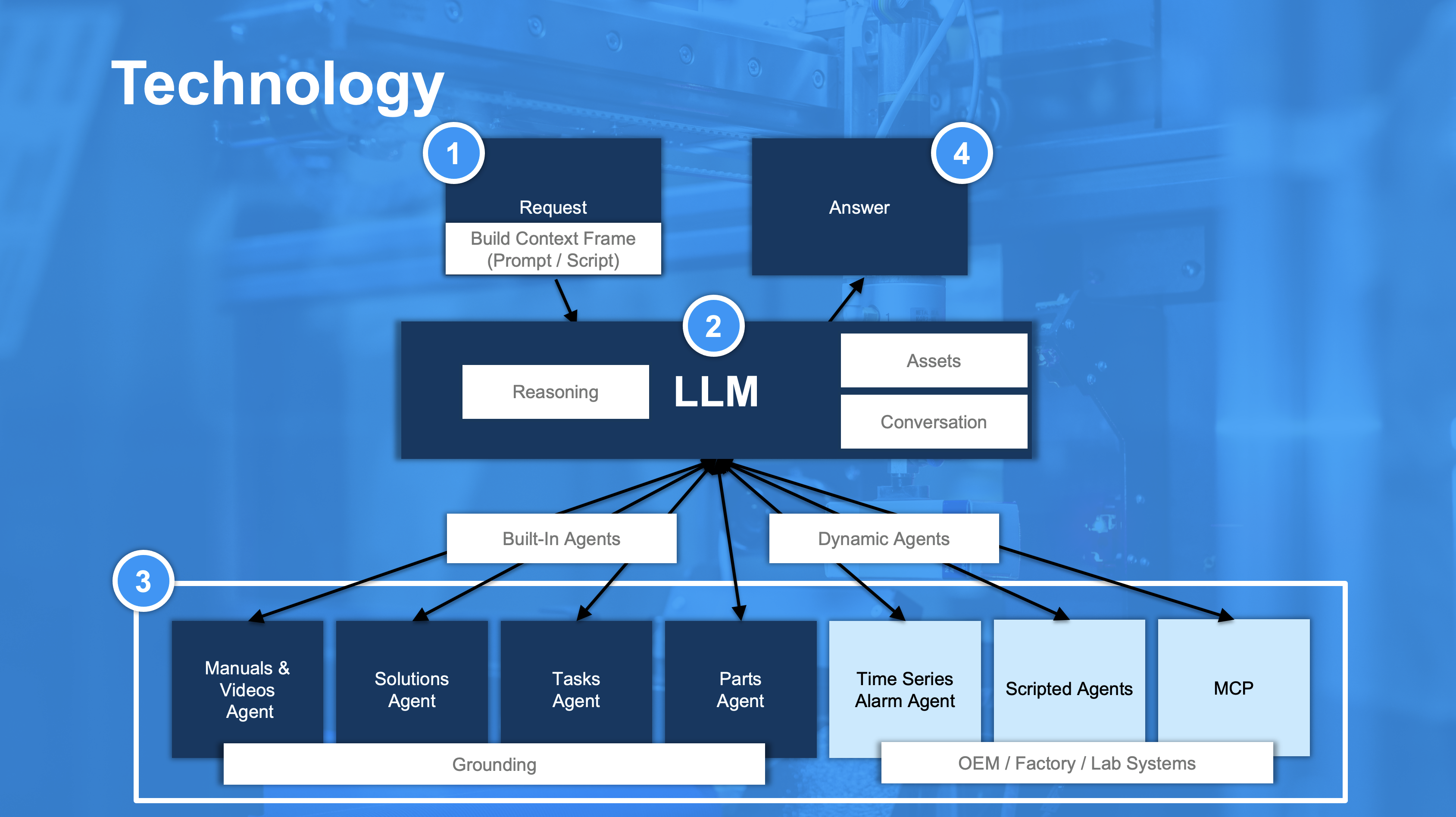
1. The Request (Context Framing)
This is where the interaction begins. Think of this phase as context engineering—preparing the LLM with the right information before it begins to reason.
When a user asks a question, runs a task, or triggers an action, the system builds a structured prompt behind the scenes. This context frame includes:
- User Intent: The raw question or command.
- Asset Context: Specific machine details, serial numbers, and current configurations.
- Memory: Relevant conversation history.
- System Directives: Any underlying rules, constraints, or instructions.
2. The LLM (The Brain)
The core intelligence and orchestration layer of the Copilot.
The LLM receives the structured request alongside the asset data and conversation history. Inside the LLM, the core reasoning happens. It acts as a routing engine to decide:
- Which specialized agent(s) to call
- What specific data is required to fulfill the request
- How to best formulate the final answer
3. Agents (Specialized Workers)
The LLM doesn’t do everything itself—it delegates specific tasks to specialized agents. These agents fall into two primary categories:
Built-In Agents (Grounded Knowledge)
These agents are securely connected to your internal knowledge base and only use verified data to prevent hallucinations.
- Manuals & Videos Agent: Searches documentation, PDFs, and training content.
- Solutions Agent: Retrieves known fixes, historical resolutions, and best practices.
- Tasks Agent: Executes and guides users through step-by-step procedures.
- Parts Agent: Looks up component specifications and replacement details.
Dynamic Agents (Live Connections)
These agents connect to real-world, live systems (OEMs, factory systems, lab systems) to pull real-time data.
- Time Series Alarm Agent: Reads live machine telemetry and active alarms.
- Scripted Agents: Executes custom, user-defined automations.
- MCP (Model Context Protocol): Manages external tools, third-party APIs, and system integrations.
4. The Answer (Final Output)
The human-friendly resolution delivered back to the user.
Once the LLM has completed its reasoning and the delegated Agents have returned their localized results, the system enters the synthesis phase. The LLM processes all the gathered information to format a clear, cohesive response.
The final output delivers exactly what the user needs, which may include:
- Step-by-step instructions
- Root-cause diagnoses
- Structured data summaries
- Actionable next steps
Updated 2 months ago